Showing posts with label Politics. Show all posts

Friday, September 1, 2017

The problem of Consent

Coming to terms with an even smaller relativism.

Good and Evil are interesting things.

The Snake said that if we ate of the fruit, we would be like God and we would know the difference between good and evil. This seems like a funny thing to tell us, given that we must have already had some idea about the difference between good and evil because we'd been told not to eat from the tree.

Still, since that time, we've been trying to figure out good and evil. I'd like to think that the main project of moral philosophy or ethics is to try to find the best way to know and communicate the good, but sometimes I wonder if the reason we spend so much time wondering what good and evil are is because we already know what they are, but want to find a way to justify the particular kind of evil we enjoy.

I hope that's not the case though. There are a lot of ways that people have thought about how to decide what's right and wrong. I kind of like Aristotle's notion that what is right is what allows people to flourish and what is wrong is what inhibits human flourishing. Of course, it is possible to take this in some weird directions including eugenics. I also kind of like the Platonic/Stoic injunction that what is right is what reason dictates is right whereas what is wrong is what reason dictates is wrong. On the other hand, reason depends heavily on the premises on which it is based and as computer programmers used to say "Garbage in, garbage out.

Hume basically thought that we know what's right and wrong based on feelings, or moral sentiments. It disgusts us to see evil and so we don't like evil. Still, I'd say that we often really like things that are really bad.

I think that Kant's categorical imperative, that we basically know what is right and wrong the same way we know that a triangle has three sides even if we don't count them because that's what a triangle is, has some traction. Still, it is a struggle to find out what these moral axioms are and, in my opinion, leaves us with having to go with one of the other systems. It's not so easy.

Some people like, Mill and Bentham, have argued that whatever does the most good for the most people is what is ethical. That makes sense, except for how do you know if it's really good?  You're back to using another system to find that.

So, I'm not saying it's easy. 

All of the men listed above have had a pretty profound impact on how I have formulated my ethical system and so while I just "wrote them off" above in a few terse sentences, that was more to show how slippery the subject is, not to say the thinking wasn't formidable.

But I feel like there's an ethical system that is just giving up and that's social relativism. The social relativists say whatever a given society says is okay is okay and whatever a given society says is not okay is not okay. It's not okay for people in the US to eat each other, but it we shouldn't go imposing those values on New Guinea. We can't really figure out what's right and wrong but we can go with what works for a given society in a given time and place.

Such a value system, or the lack thereof, works well for doing anthropology. It's not a terribly useful exercise to go to a far away country and write back home about all the things the other country is doing wrong. If you want to study them, you should try and figure out why they think those things they're doing wrong are right.

However, it doesn't provide much guidance on how to live one's life, especially in a diverse society. It's pretty easy to find people who will tell you what you're doing is okay. Then that becomes your society. Since that is your society and since you know good from evil based on your society, everything is okay, which it's not.

But it's gotten worse

As problematic as social relativism is, it has gotten worse. Lately, I've been hearing about an even smaller form of relativism: consent. This has been going on for a while. Basically, since you can find a group who is small enough to condone whatever you're doing and that is your society, if you can find them, it is okay. As long as what you're doing doesn't directly effect other groups ability to do what they want you should be able to do whatever you want. As long as everyone involved is consenting, everything is okay.

But where do these rights come from?

I admit that I was taken in by this tiny relativism for quite a while. As a principled Western libertarian, I often said "my right to swing my hand ends at your face" and I still see that as true. But at some point I have to ask "why?" And if the answer is "because you didn't give consent to hit me." I can pretty quickly go from there into all the ways that you DID give consent.

You knew when you saw me that I was a hand swinger. I had a shirt on that said so, but you still came in swinging distance, so you agreed.

Some of the pro-consent crowd have altered their verbiage based on this to "affirmative consent." Maybe that makes it a little better, but if I "affirmatively consent" to have you pour chemicals in my eyes so I can be blind, that is still wrong. Why is it wrong. It inhibits human flourishing. It is unreasonable. It is repugnant. It violates directives. . . all those ethical reasons I put above. It is just plain wrong, even if I consent.

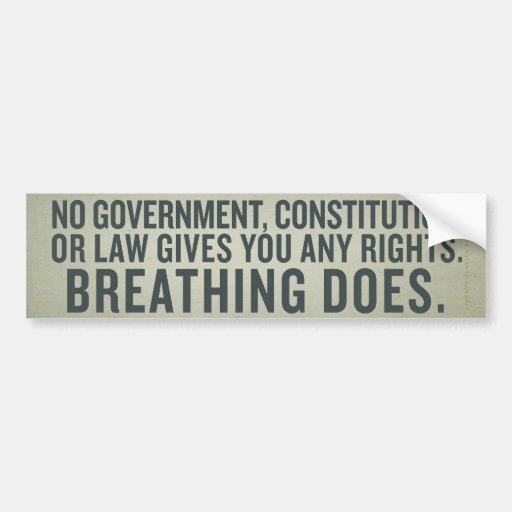
Yet, I do believe in our rights to life, liberty and property. That's why I'm libertarian, but I don't believe that these rights exist from the consent of the governed. I have to say that I think that we are endowed by our Creator with certain inalienable rights, and that those are among them. That same creator is the source of goodness. And then, it is up to us to find what is good. And it's not just what we can find someone to consent to.

Tuesday, July 4, 2017

They hate us for our freedoms . . . which is a reasonable position

Coming to terms with why they hate us, and I sometimes do too, on the 4th of July.


On September 20th, 2001, 

in the wake of the horrible terrorist attacks earlier that month, President George W. Bush addressed the nation. He answered a question that many of us were asking at that time:
Americans are asking ``Why do they hate us?''
They hate what they see right here in this chamber: a democratically elected government. Their leaders are self-appointed. They hate our freedoms: our freedom of religion, our freedom of speech, our freedom to vote and assemble and disagree with each other.
Of course, like all statements made since the internet boom of the mid-nineties, the statement was quickly mocked.
And like all mocking, the mockers had their point. There was certainly more to it than that. American foreign policy with regard to the parts of the world in which Islam is dominant is, to say the least, fraught and complicated. Furthermore, anyone can understand the notion that if you are on the fence regarding your opinion of a country, and that country bombs your children, you will pretty quickly choose a negative position.

But make no mistake, they do hate our freedom. The Islamic Caliphate, known as ISIS, which has risen in years since
 then makes that clear. The Caliphate is worldwide. The Caliphate is the only legitimate expression of Islam. The Caliphate is opposed to any sort of Western Liberalism.

It is not just against bombings. It isn't just against Western oil companies on holy soil. It is opposed to Western Liberalism.

And I get it.


I don't care what side of the political spectrum you are on, if you went to the 4th of July parade today there was something to offend you, deeply.

I was offended. I was offended at baseball teams who were playing music on their floats, full of minor children, playing music with lyrics that were openly misogynist and graphic in their depictions of sexuality. I wasn't exactly offended by the somewhat provocative dances performed by teenage dancing crews in fairly little and fairly tight clothing, but I know how interested my 3 year old daughter is in taking dancing lessons. Will I be as calm about it in 10 years? Will she feel free to wear something other than these uniforms if she's not comfortable with it? I don't have anything against women, even young women, wearing what makes them feel comfortable and desirable, but I do not like people feeling that they must conform to the hyper-sexualized society.  There were floats from religions that I really don't want to have their message legitimized. There were floats for people whose politics disagree with mine. There were floats from groups whose lifestyles I would really prefer my daughter didn't even know existed parading their twisted views in front of everyone. There were open displays of disrespect for authorities that I see as God ordained. It made me angry.

So, I understand an impetus to dress them all in burkas, beat the ones who are disrespectful and un-submissive into respect, submission, or death, murder those who you find offensive. I really do get this. I really do hate our freedoms too.

And you get it.


Like I said, whatever your side of the political spectrum, there would have been people who you would have liked to silence too. There were showcases of American military respect, honoring veterans. There were floats arguing that you can never respect a country that uses violence. There were Republicans, Democrats, Christians, Atheists, etc. etc. etc. Think of some group who you think is dangerously nuts. They had a float in our parade.


And even though I get it, I love it.


Did my Grandpa fight at Iwo Jima for people to get up and say and do all these things that make a mockery of his values? Yeah, kind of.

See George W. Bush was right. They DO hate us for precisely the values he listed: "our freedom of religion, our freedom of speech, our freedom to vote and assemble and disagree with each other." It's not just our religion they hate, it's the freedom of religion. It's not just our speech they hate, it's our freedom of speech. It's not just that we disagree with them. It's that we have the right to disagree
And we all have that authoritarian living inside of us. There is that person who says "they shouldn't even be allowed to say that." Or "if they think that way, fine, let them think that way at home. Don't make me look at it." But that is not the American in us.

I disagree with what you say, but I hope that I would have in me to fight to the death for your right to say it. 

Friday, February 17, 2017

To my liberal friends from a conservative.

Coming to terms with working with liberalls

I'm a conservative

I generally see myself as a "conservative" although that term has become so contested, so controversial, and so tribalized that I don't know if the fact that I consider myself that means that any other person who uses the same appellation would ascribe the label to me. That's okay.

What I mean by that is that I espouse most traditional Judeo-Christian values regarding individual morality and family roles. I usually think free markets work better than regulation for most people. I espouse virtue in an Aristotelian and Aquinian sense. I value the Western Tradition. I believe in American exceptionalism, but don't believe it is inherent or something up to which our country has lived, rather that it is put forth as an ideal in our founding documents. I see the government as untrustworthy, yet I still try to follow the laws in most cases mostly because I don't see much value in making waves. I try to be extravagant in my respect to people who serve this country in the military or police. I think that the tried and tested generally functions better than the latest fad. I wear a button down shirt and a tie to work usually. I like "everything at the right time –dinner at dinner time, lunch at lunch time, breakfast in time for breakfast, and sunrise at sunrise, and sunset at sunset," the description of a conservative in the classic work of political philosophy, Mister Dog: The Dog Who Belonged To Himself. I hesitate to say this, since if I do I will undoubtedly make grammatical mistakes in this blog, but I generally try to use standard grammar and proper verbiage. I make errors in all these ideals, but I try.


I don't particularly like President Trump. I did not vote for him. I have liked some of his decisions, even controversial ones. I liked the choice of Betsy Devos for secretary of education because I believe in the very conservative idea that parents should raise their children, not the state. While an education is essential in that rearing, I don't think that the government, especially the national government, should have much say in how that education is accomplished. I have liked Neil Gorsuch as a pick for Supreme Court Justice because I think that the Constitution is supposed to be a document that constitutes our government and guides our politics rather than our politics being used to constitute the document. 

I have strong disagreements with the President Trump, however. First of all, the man has shown himself to be a cad, which is a word we need to bring back to the English language as a means of policing men's improper foibles rather than decrying "misogyny" or "rape culture" both of which exist, primarily because we don't keep our cads in check by calling them cads. Secondly, his blustery language and apparent lack of self control in tempering his responses are not conservative virtues. His populism flies in the face of conservatism catering to certain people through demagoguery rather than appealing to them philosophically. His foreign policies seem to smack of the idiocy of Smoot-Hawley and a fear that Western culture cannot stand up against the barbarism of contemporary west Asia and the militant forms of Islam that have established themselves there. Much like the identity-politics of the left, he has rejected the melting pot and thinks that people who come cannot be Americanized within a few generations. I hate that kind of thinking. It is not "conservative," at least not by my definition. 


So it is from this point of view that I offer my recommendations to my left-leaning friends (which I think would describe most of my friends). I am a conservative, so I have a different point of view than you. Still, I think in my disapproval of President Trump might mean people like me are someone with whom you can work, if you are willing to work.  You don't like Trump because he's not a liberal. I don't like him because he's not a conservative. Here's a list of things you have to do, however, so we can join forces to limit the damage he can do.

First of all, you have to accept that Trump is President.

I am well aware that he did not win the "popular vote." I don't care. The popular vote is not a measure of legitimacy. The Constitution wisely developed a system of Representatives and Senators which correspond in numbers to an electoral college that would create a balance between the desires of the majority of the country and the majority of the people in the country. The former being spread out throughout the nation, the latter being clustered in a few geographically small urban areas. The majority of the people is taken into account, but Wyoming, Vermont, and North Dakota (the least populace states) do not have to accede to the will of California, Texas, and New York (the most populace). This is a good and fair system. If you don't shut up about the popular vote, your open anti-rural bigotry is going to push people into Trump's flailing arms. Acting like the popular vote matters is insulting to anyone who lives in a rural state. 

Furthermore, he is likely to stay President for the next several years. Feel free to look for 2020 candidates, but more and more of my liberal friends are calling for President Trump's impeachment. That hope is foolishness just as it was for many of my right leaning friends who wanted President Obama impeached. It is simply not going to happen.

While many elected conservatives feel much the same way I do about President Trump, there are partisan constraints. Furthermore, none of the disagreements about which I have are actionable. They are personal. From what I have seen from my liberal friends their disagreements are political or personal but not law breaking. Those few cases where there may be legal issues don't rise to the level to which they would need to rise to overcome partisan loyalty. In other words, there is nothing being alleged about President that, if true, would make a Republican want to impeach him. Conflicts of interest, if proven, could be divested before any impeachment proceedings. Ties to foreign governments can be mitigated in a variety of ways. Even allegations of fraud are not adequate to make a person vote against a member of his or her own party. 

Right now you are simply not going to get the Republican-led House of Representatives to file articles of impeachment. That could change in 2018. It is possible that the Democratic party could capture the House. There are more than the necessary 14 seats in play. Traditionally the party of the President loses seats during midterms. You might get enough people to file articles. Okay, then what?

Then it goes to the Senate where 2/3 of the Senators are going to have to vote to remove him from office. It is not going to happen. Right now Republicans control 51 seats and are barely hanging on to a simple majority. The mid-term elections, as I said earlier, normally go against the President, but the 2018 elections will not. There are only eight Republican Senators coming up for reelection, none of which are listed as "toss-ups" by any of the three major raking agencies (Cook, Roth, Sabato). Whereas there are Democratic seats that are. This means that unless something unforeseen happens, Republicans will control the Senate and unless he's done something that will cause felony charges to come against him, they aren't going to remove a President of their own party from office. Give up on that dream. Party loyalty is not what it is in some countries, but there is enough that you'll never hit a 2/3 majority in the opposition with this President in four years. So, give up. As long as you're working against him you are not working for anything and there are things for which we can work.

Don't be too freaky to be someone with whom I can work.

I certainly admit that "liberal" and "conservative" are as much lifestyle choices as political boundaries. I don't expect you to be like me. Liberals and conservatives both like camping, for instance. I'd love to invite you to go camping with me.  I'm probably going to be roasting 89¢ per pack hot-dogs over my fire and you'll be eating organically grown kale mixed with non GMO nuts. We can offer each other some and accept or decline. I don't care. Actually, 10 years ago I would have been like you. I would say I've grown up. You might say I've sold out. I don't care. I can still go camping with you. You can even beat your Djembe and sing songs that express Hindu principles in a Native American style at the fire. Afterwards, you can talk about how uncomfortable you are with the juxtaposition of needing to experience authentic spirituality while not wanting to appropriate. I don't mind. There are a lot of things like that. We can do them together and as long as you let me be me, you can be you. You might be surprised just how "liberal" I am in these areas. I'm a bit of a crunchy con, but even conservatives who are not won't mind you. We have actually a lot in common.

Still there is a line I'm going set. If you condemn me for eating hot-dogs, it won't make a good camping trip for me. If you think being out in nature means that you need to be au naturel, I am going to be pretty uncomfortable. If you decide to bring along a partner and make love while sharing a tent with me, I'd have to excuse myself. If you decided this space away from the auspices of law enforcement was a great opportunity to enjoy some recreational pharmaceuticals, well, look, I'm not at that place in my life socially anymore nor do I wish to go camping with those who are right now.

Most of you would say, well, Dr. Cline, Rhetorical Questioner, I would never do those things if I went camping with you. Those are cruel liberal stereotypes. Of course they are! That's why I invited any liberal who happens to be reading my page to go camping with me two paragraphs ago. We'll have fun.

But the thing is, political action is a lot like camping. Conservatives can protest President Trump's inappropriate comments about women that point to actions even more inappropriate. However, for me to join with you, wearing a knitted hat designed to look like a vagina is just not going to fly. Good for you for having one, I guess, but you're not going to bring any conservatives to your cause. You are going to look like a nut (or, I suppose, the female equivalent). Many conservatives feel that legal immigration should be expanded and that immigrants who came here illegally as small children unable to make their own decisions and who have grown up basically Americanized should hardly be "deported" to a country they never knew. That's silly, which is why there's never been Republican consensus (or Democratic consensus for that matter) for or against the D.R.E.A.M. act. The act was sponsored by fricken' Orin Hatch and you don't get better conservative credentials than Orin Flippin' Hatch. This is an area where we can work together, like camping. If you're carrying an "amnesta para todos" sign, well, that's a sign we can't sign on to. Of course we believe that Black Lives Matter and want reform of the criminal justice system. Rioting and burning, however, makes us distance ourselves from your cause.  Do you get this? My mom in rural Nebraska is not swayed to any political action in favor of people wearing vagina hats.

Pray with me. Love one another with me. 

If you're an atheist liberal, probably you won't pray with me. Atheist conservatives like Austin Petersen, George Will,  or the various followers of Ayn Rand's objectivism won't pray with me either. I won't say then "let me pray" because while I've heard of atheists who won't let theists pray around them, I've never met them. They're generally like, "knock yourself out, and wish on a star while you're at it." So, how about this? Agree with my prayers.

Lots of liberals I know, however, are led to a liberal position by their faith. The idea of setting the captives free, caring for the poor and sick, aiding widows and orphans in their affliction, and standing up for the foreigner and the alien seem to fit better with the Democratic party than with Republicans. That makes sense. Most conservative Christians see these as personal commandments and not something we accomplish through the government, but we get where liberal Christians are coming from.

Abraham Lincoln is quoted by sources whose veracity I cannot gauge as having said "Sir, my concern is not whether God is on our side; my greatest concern is to be on God's side, for God is always right." So, let's pray we are on God's side. So, let's pray for our leaders. Let's pray they be filled with temperance and wisdom. Let's pray they make the right decisions. Let's ask that our own lives be made beacons of light to a world, we both agree, needs it badly. Let's pray for God's will to be done on earth as it is in Heaven. Let's pray for a growth of love and truth in our country. We can do that, can't we? I am not a fan of President Trump, but I'd rather he experience repentance than that he be impeached. Honestly, wouldn't that be your preference too?

And we can be kind to each other. We have disagreements. But let's generally assume that those disagreements both come from a place of goodness and if we can't accept that, that it comes from a place of pain. We need to care about each other's pain. 

Monday, June 13, 2016

Orlando

coming to terms with the Orlando shooting.

What a rich site for us to mine all the demons of our present age: Muslims, guns, gays, Latinos! It makes me sick

I completely agree with Austin Petersen's recent tweet that
Of course, no one is innocent. Christianity teaches that "All have sinned and fallen short" (Romans 3:23). Hinduism says that every bad thing that happens is because we did something in another life to deserve it and that we should, for that reason, "enjoy" the terrible things that happen to us, in that they have worked off some of our Karma "without making any complaint of it" (Nada Bindu Upanishad verse 21). Buddhism teaches that bad things happen because, even when we do good things, we always intend evil:
"Intention, I tell you, is kamma. Intending, one does kamma by way of body, speech, & intellect.
"And what is the cause by which kamma comes into play? Contact is the cause by which kamma comes into play.
"And what is the diversity in kamma? There is kamma to be experienced in hell, kamma to be experienced in the realm of common animals, kamma to be experienced in the realm of the hungry shades, kamma to be experienced in the human world, kamma to be experienced in the world of the devas. This is called the diversity in kamma (Nibbedhika Sutta: Penetrative).
In Islam they say that “If Allah were to punish men for their wrong-doing, He would not leave, on the (earth), a single living creature (16:61).

Greek myth posits the evil inside us as originating with hubris (Pandora, Icarus, Narcissus, I could continue ad nauseam). We who are unholy have chosen to touch the holy thing, and deserve what comes to us.

I think when we find some teaching that is pretty universal, it is something to which we should pay special attention. God seems to have written it on people's hearts, regardless of religion.

Every religion and every philosophical system that holds any serious water agrees. We all deserve to die horribly and painfully, certainly, and probably go to Hell in most religions. And I think we all know it.

Yes, we deserve horrible things to happen to us. We have no right to complain when they do, only to cry out for mercy (not necessarily a universal, but I don't think I could handle a faith or philosophical system without it).

I don't think Peterson meant "innocent" in this sense. He meant it in a very earthly sense. There should be, in a just society, particular consequences (I hesitate to say "punishment," but maybe) for particular crimes, not just a constant vague torture for vague probable failures in the spiritual sense. Perhaps even an "eye for an eye" but not a son for an eye. There needs to be a human-type of justice that handles cause and effect with due process in the human world. We need due process. We need courts. We need juries of our peers.

And in this sense, there are so many "innocent."
  • Innocent LGTB bar goers who have another reason to fear violence. Who see their basic rights to their own body curtailed by fear.
  • Innocent Muslims, who need to worry about ways in which a reactive public might curtail their freedom of conscience.
  • Innocent Latinos who know that this murderer did not just choose a gay bar, but a gay bar on "Latin" night because people with varying degrees of documentation are less able to protect themselves. 
  • Innocent gun owners who are worried that their basic human right of self defense will be curtailed by another part of that reactive public. 
  • Innocent journalists, writers, and thinkers who somehow have to "come to terms" with so many different aspects of right and wrong in a way that calms the reaction, elevates the conversation, and still, sadly, sells copy.
Fear and reaction are the entire point of terrorism. That's why it gets its name. It instigates violence, but it insights terror. Fear makes us do stupid things.

Like take away people's rights and liberties
Like blame innocents because of association
Like blame the victim.

Because if people didn't have the right to protect themselves, they couldn't hurt others.
Because if people of a certain type would do this, then all we have to do to protect ourselves is eliminate that type.
Because if the people who did this deserve it, then it can't happen to us. We don't deserve it.
Then we can feel safe.
Because WE
(those who don't believe in guns, heterosexuals, non-Muslims, whatever)
are innocent
and THEY
are not

But we shouldn't feel so safe
because we're not innocent either.

Wednesday, March 2, 2016

Who I would vote for in order and what I imagine as their D&D Alignments and Classes

Coming to terms with this election.

Increasingly I see American politics as just a game. Specifically, I think it is Dungeons and Dragons.

Marco Rubio (Rep. Neutral/Good, Bard): 

He has a clear, coherent philosophy in the tradition of John Locke, the federalist papers, and Adam Smith all informed by a Roman Catholicism informed by Reformed theology from Tarkio. People’s objections to his Gang of Eight bill show me that he is thinking about serious immigration reform, even if it’s not what you want. Critiques of his conservatism because of this are silly. Conservative political philosophy has never been for heavily restricted immigration.

John Kasich (Rep. Neutral/Good, Wizard): 

By far the most rational candidate running today, it is a rationality only informed situationally rather than by principle. Still, I strongly believe in careful, rational thought.

Ben Carson (Rep. Chaotic/Good, Cleric): 

He is brilliant and guided by principle, but not ignores facts that contradict those principles. Those principles are good ones though.

Bernie Sanders (Dem. Lawful/Good, Monk): 

What? Really? Before so much of the field? Yes. While I disagree with Bernie’s view of economics, I understand it. I know where it comes from. It is coherent. I really believe it is better to be guided by a strong philosophy, carefully thought through than by polls. Therefore, I’d vote for someone who is guided that way.

Ted Cruz (Rep. Lawful/Good, Paladin): 

Hegelian statism is my biggest objection to Cruz, as it is against Sanders (To me, Hegel is Lawful Neutral). The reason it is worse in Cruz is that somehow he tries to make it fit with Constitutionalism, which it doesn’t, except where he disagrees with it in terms of education. This kind of philosophical inconsistency makes me uncomfortable with a candidate. It makes me wonder if he adopts core beliefs in keeping with something other than coherence.


Gary Johnson (Lib. Neutral, Ranger): 

I voted for him in 2012 because he was the best choice. I still believe he was the best choice in that race. He’d be a pretty good choice here. Other than Johnson and McAffee, I haven’t ranked the rest of the Libertarian field here because I don’t know too much about them.  He probably has the philosophy I agree with more than anyone else here, but it is not informed by faith and has some tendencies toward inconsistency.

Hillary Clinton (Dem. Neutral/Evil, Sorcerer): 

Not quite America’s worst possible choice. She has no principles and no rationality beyond Machiavellian self-interest. She would, however, aim that self-interest at “legacy” and changes that will make it possible for her family to continue selling their product after the term ends. That means she won’t do intentional damage unless she thinks it would be popular to do so.

John McAfee (Lib. Chaotic/Neutral, Rogue): 

I totally admit the man is insane. My biggest fear is that he’d just do the whole executive branch himself and he’d fire everyone else. It would run like clockwork for a while then he’d get interested in some project besides the whole “President of the United States” thing and just go do that and let the country crumble. I am not joking. He is the typical brilliant programmer with extreme ADD. If he can stay focused on being President, he would make it stream-lined, efficient, and even mathematically elegant. Everyone here or below is not okay. Still, I would vote for this guy with the gun to his head before I voted for the next guy.


Trump (Rep. Chaotic/Evil, Barbarian): 

I would not vote for Trump if a trained monkey were running against him. The man has no coherent rational views: not even, really, self-interest in the classical sense. Self-promotion is not the same thing. He’d completely destroy even himself to garner more fame. He would completely use a nuclear bomb just to get his name out there. The man is awful. CNN just reported that “America's most unpredictable candidate could turn into America's most unpredictable commander-in-chief.” At least Hillary Clinton could be counted on not to do anything that would make her look bad to more than 55% of the population and McAfee really could do things well if he remembered to. Trump is Chaotic Evil. 

Monday, February 15, 2016

Don't freak out about these Political Machinations

(Coming to terms with American civics)

Things to know about what's going on regarding the Supreme Court:
  1. Republicans and Democrats are the two major political parties in the United States.
    1. The United States is largely a two party system, thus making these two parties pretty powerful.
    2. While Republicans and Democrats actually agree on most things that are controversial in other countries (a Constitutional Republic form of government, free ownership of property, a basic set of individual rights, a citizen military, income tax as primary revenue, free trade with allies, a non-command economy, etc.), most Americans see Republicans and Democrats as opposite.
    3. While the majority of Americans do not see themselves as Republicans or Democrats, those who do seem to feel strongly that the other side is quite wrong.
  2. The Constitution of the United States posits three branches of government. Ideally:
    1. The Legislators makes laws
    2. The President executes those laws and runs the bureaucracy that executes those laws.
    3. The Courts make sure the Legislators and the President are acting within the limits of the Constitution.
  3. The Constitution of the United States gives the right to the President of the United States to appoint Justices to the Supreme Court (and other federal courts too).
    1. A Supreme Court Justice has his or her position until deciding to retire, or dying, whichever comes first.
  4. A Supreme Court justice, Antonin Scalia, recently died.
    1. Antonin Scalia was appointed by Ronald Reagan, a Republican.
    2. Antonin Scalia has almost always voted the way that the Republican party would want him to on the Supreme Court.
    3. The current President of the United States, Barack Obama, is a Democrat.
  5. The Constitution of the United States gives the Legislature power to "advise and consent" to these appointments. 
    1. If they do not consent, there is no appointment.
    2. The majority in both houses of the Legislature are Republicans. 
    3. The Legislature can deny consent, but even if they don't want to go that far, they can take as long as they want to deliberate. 
  6. There is a Presidential election in nine months. 
    1. The Republican Party thinks that they might win that election.
    2. They all know that they also might not.
    3. If the Republicans can hold off the new Justice, and the next President is a Republican, they might be able to get a justice who will agree with them on most issues.
    4. On the other hand, if they do this, they might be seen as "obstructionist" by the people who are not Republicans or Democrats and might lose the election because of that.
    5. If the Republicans lose the election, they will have gone to a great deal of work for nothing.
  7. In the end, you'll hear a lot of people talk about precedent, Constitutional powers, intent, and other things, but the truth is that both parties just want to put their person on the courts, plain and simple, and all this other stuff is just justification
The fact of the matter is that it is all just politics and positioning. The Republicans and Democrats would be doing the exact same thing that the others are doing if the situation were reversed. Maybe politics itself is distasteful. Maybe we wish that Justices were chosen by merits or elections instead of appointments. That's not the way it works though. So, I have a feeling emotions are going to run really high about this whole thing and people are going to get real upset with each other. 
Don't.

All of this is just the way things work and at most it will be nine-months before it all shakes out. It'll be okay. 

Friday, November 14, 2014

Freedom of Religion

Coming to terms with freedom of religion.

There are different ways that faith can be handled in public. One option that many legal systems (from 18th century Europe, through the USSR to ISIS) have used is to have the governmental or quasi-governmental agencies tell you what your faith must be. Another way of doing things, is allowing whatever faith you may have, but limiting the ways that you can express that faith in public. France not allowing Muslim women to wear their hijab to school, or Chinese taking the large crosses down from their churches, or making house churches illegal are examples of this. In America, we've made another choice: pluralism. The first amendment says "Congress can make no law regarding the establishment of a religion or prohibiting the free exercise thereof." What that means (barring some extreme examples) is that I can't make you follow my religion, but you can't stop me from publicly practicing it.

Pluralism isn't perfect. It allows people to have religions really far outside the norms. There are churches of Satanism and of Flying Spaghetti Monsters (a religion that mocks religion). There are religions that emphasize biofeedback and that emphasize sitting in silence to stop all feedback. There are religions that require their adherents to give them a percentage of their money. There are religions that require all members to be celibate. If any of these religions sound awful to you, don't join them. Pluralism allows that too.

Pluralism also isn't total freedom of religion. If a Rastafarian smokes marijuana (which is an important part of Rastafarian-ism), then he doesn't get arrested for being Rastafarian, he gets arrested for smoking pot. If a Muslim wants to sacrifice a goat for Eid-al-Adha, which the Muslim would have to do, they have to be in a place that is zoned for killing animals. If they are not, it is not the religion that gets them arrested, it is the violation of zoning restrictions.


I recently heard about a student who is in trouble here at the University where I teach for openly asking God to help her with her work. Now, I don't know the details. Maybe she was being disruptive when she did this (I know the student, and that would be acting against type, but we all act against type sometimes). Maybe her prayer was interfering with other students getting work done. I don't really know. I sort of think that probably she is in trouble because people don't really understand the First Amendment. They somehow think that a "separation of Church and State" implied by the First Amendment means that a person cannot practice their religion in a "state" area. Or they think that religion needs to be silent on government issues.

Neither of these are quite correct. Certainly, I, as a teacher cannot impose my religious beliefs on my class. That would be me, as a government official, establishing a religion.  Nor do I have to keep those beliefs a secret. I am not going to lead my class in prayer at my state institution. I am not going to tell them that they have to follow my religion. I certainly wouldn't be okay with someone leading me in prayer for a religion other than mine. On the other hand, if someone tells me about their religion, it's okay. And if my students choose to pray on their own, in a non-disruptive way, even to a god I don't believe in, that's fine.


And it's not just "fine with me." It has to be fine. Students have the right to the free exercise of their religion. If it's a disruption, then yes, they can suffer the consequences for disruption. If it interferes with the curriculum, then they can get in trouble for interfering with the curriculum. If it is a simple prayer, we cannot prohibit the free exercise of religion. If it is

Tuesday, February 11, 2014

Stop The NSA

View the banner below to see how we can fight mass surveillance.

Thursday, April 18, 2013

A reasoned rant

Coming to terms with human rights.

This is going to get political.


Political discussions are hard which is why we hardly ever have any. There is either screaming or yelling and sloganeering or ignorant platitude that ignores the real issues. Part of the reason that they are hard is that politics stem from ideology, which the rhetorician William R. Brown described in the late 70’s as “that category of experience on which one is willing to bet the meaning of one’s life.” To lay one’s life’s meaning on the table like that and not get defensive when it is challenged is hard. To take as serious the points of view that run counter to the meaning of one’s life is hard. Instead, we get angry or we ignore others and write each other off as wackos or get in each others’ faces and “confront” each other. None of that is really productive, but it feels like our only choice.

Maybe there are other options. Maybe we can sit and explain the basic philosophy that undergirds our political beliefs and while we still might not agree with each other, maybe there is some chance that we can come to some kind of recognition that the other side is NOT a wacko. Maybe we’ll continue to see the other side as wrong, but not evil. That, to me, would be a powerful move in the correct direction.

So, I’ll begin with me. I’ll explain the basic philosophical discussions that undergird my opinions regarding the role and scope of government. Then maybe you can do the same. Maybe we can have longer, blog-length discussions about these issues instead of facebook/twitter length discussions. Oh, I am a realist. Probably we will all back into our corners, lick our wounds and think about how evil the other guy is, but at least we tried.

Rights and their sources:

First, I believe that rights exist independent of any type of state or government. I believe that they are given by God. States or governments can recognize or fail to recognize these rights, but the rights are still a person’s rights regardless of the decisions of those in power. Others may attempt to coerce one into not exercising one’s rights or punish one for doing so, but they are still, as the Declarationof Independence says, “inalienable rights.”

I think that there are a lot of rights that God has given us. Still, Locke’s trio of life, liberty and property are a good place to start because of their mutual balancing. Life is perhaps the easiest to understand. No one can take another person’s life. Liberty is the right not to be coerced. No one has the right to coerce another person into any action whatsoever. Finally property, which is the ownership of what one earns or creates when applying labor to nature’s abundance and God’s grace. No one has the right to take another person’s property or tell him or her how to dispose of it.

The right to responsive violence:

But what if someone does? Sheltering these three rights and a host of others is an assumed right that is rarely discussed: a right to responsive violence. Should a person attempt to take your life, coerce you into anything or attempt to confiscate or destroy your property, you have a right to engage in violence equal to the necessity required to halt such infringement or die trying. The right to responsive violence does not mean that you can infringe on others’ rights to life, liberty or property. Your right to responsive violence does not mean that you can take lives of those not currently attempting to take yours. It does not mean that you can legitimately use violence to coerce others. It does not mean that you can use violence in order to force others to relinquish their property. The right to responsive violence does not allow for coercive or preemptive violence. It means that one has the right to respond violently to violent intrusion.

The Nation-State is Suspect.

In order to protect these inherent rights from violence, people have traditionally banded together. One’s own inherent right to responsive violence can be shared among a group so that if a neighbor’s life, liberty or property is being violently assaulted, one can, with the neighbor’s permission, work together to violently fend off such attacks. Furthermore, we have found as a species that any number of our labors is more fruitful and enjoyable when shared. However, there are limits on the extent to which we can share. Coercing a person into sharing his or her labor is chattel slavery. This type of slavery violates notions of both liberty and property and has a huge probability of ending in a violation of one’s right to life as well. Coercing a person into sharing the fruits of his or her labor is theft and is a violation of the right to property as well.

Because no one has the right to violate life, liberty or property, the nation-state is a problematic concept. While people are able to work together to pool resources and incorporate in order to better their lives, protect their liberty and increase their property, they must be free to leave such agreements whenever it is no longer satisfactory or it is coercion. Coercion is a violation of liberty and is therefore wrong. It is such a problematic concept that God declared that the formation of a nation-state a “rejection” of Him (I Sam 8: 7). Smaller local and temporary governments were fine and necessary. Voluntary grouping of individuals is a good thing. Coercion, however, is wrong, always.

Nation-states have a tendency to use coercion not only on those outside their borders but on their own citizens. Citizens regularly have their labor confiscated in the form of taxes and while this is sometimes beneficial, it is hardly ever consensual. Often behaviors are regulated in the form of laws which if violated result in the loss of liberty, property or life. While these behaviors, if violating others’ rights, should be met with responsive violence, this is not always the case. Often laws are created with the idea of preemptively attacking the “criminal” before such violations are carried out. Such preemptive and coercive violence is always wrong. In fact, it is part of an individual’s right to violence to return violence in such instances.

There is No Legitimate Monopoly on Violence.

Many thinkers, wishing to justify the nation-state, have insisted that in the creation of the nation-state there is a simultaneous construction of an entity which has a legitimate monopoly on violence. Of course, I am thinking of Weber here, but even thinkers as recently as Presidents George H. W. Bush and Barrack H. Obama have espoused this notion that nation-states have a legitimate monopoly on violence. There are two major means by which this is understood and both are wrong.

Certainly, a person can voluntarily pool resources with others and make voluntary agreements to limit and direct his or her right to responsive violence. It is reasonable for someone who is not particularly skilled at martial affairs to engage in activities at which he or she is good and from the proceeds of those activities engage someone more skilled in combat to engage in responsive violence for him or her. In a free community, some might be employed in various roles and the free trade of their skills and some of those skills might be soldiers to whom the members of the community voluntarily contribute to their welfare in return for not needing to focus on protective violence themselves. However this does not constitute a true monopoly on violence because any member of a free community, being free, could extricate him or herself from this arrangement and take responsibility for responsive violence on his or her own. Voluntary incorporation does not imply monopoly.

Others seem to imply that the creation of a nation-state suddenly creates an entity that can legitimately engage in coercive and preemptive violence. Of course, that’s what any bully wants you to believe, that he or she has the right to be preemptively violent and coercive. This is a dangerous mindset into which many people have bought and which has allowed many people not to realize the rights that they have. These rights, however, are truly inalienable. Neither the nation-state nor anyone else has the right to engage in coercive or preemptive violence against anyone. No matter how beneficent the leadership of the state feels that the coercion is, they have no legitimate right to engage in it. Only responsive violence is ever legitimate and that is held solely by the individuals whose personal sovereignty is violated. The state cannot legitimately coerce a person.

There is No Social Contract.

Some, such as Rouseau, have argued for the legitimacy of the state as an instrument of violence by referring to a social contract. Since contracts are a means by which people can willingly incorporate, share their property and agree to means of enforcement, participation is not coercive or preemptive because it is agreed upon by all signers. If I agree that I will give you sixteen apples for sixteen oranges, get the oranges and refuse to give you the apples, any violence in which you engage with me to get your sixteen apples is not coercive violence but responsive violence because by lying, I engaged in violence to fraudulently acquire your property. It is reasonable and right that violators of contracts be violently held to the agreements by which they acquired goods and services.

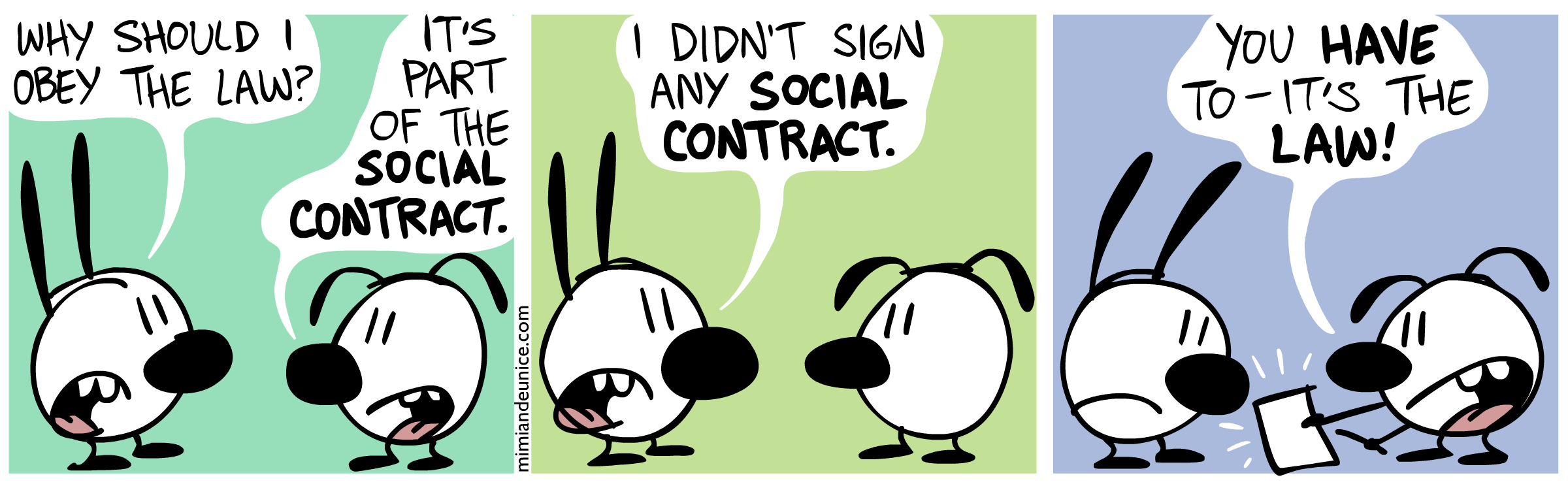
However, the existence of this social contract is seriously in question and even if it does exist its validity is nullified. I never signed a “social contract” and neither have you. The reason we’ve never signed one is that one probably does not really exist. According to most people who accept the concept of the social contract, we “signed” it by accepting the goods and services of the nation-state and are therefore unable to remove ourselves from it until our obligation is paid, which it never will be, and therefore we are chattel-slaves to the state. The nation-state “signed” it by providing goods and services, such as military protection. The problem with this is that we were not aware at the time of our birth that by accepting being born into a world with roads and bridges we were going to be forced into things like military conscription. If we had been able to, we might have made another choice.

Contracts are a means by which free parties can negotiate shared terms whereby they will agree to handle their business. The terms of the social contract, however, are by no means a negotiation. Should a person wish to interact with a nation-state on terms other than those chosen by the nation-state, one is unable. Now, a take-it-or-leave-it contract does not necessarily invalidate the contract, but there still does have to be the choice to leave it. Any contract is invalid if signature on that contract is coerced. Choosing a social contract is coerced, and claiming that the coercion of the nation state is valid because of the social-contract is saying that coercion is acceptable because of coercion.

So, whether on the grounds of a legitimate monopoly on violence or on the grounds of a social contract, the nation state has questionable validity. Certainly, it does not have the right to coercive violence. No matter how much it may be in your own best interest, neither the nation-state nor anyone else has the right to coerce you into anything.

Still, the nation-state exists.

The nation-state continues to exist and continues to coerce and I don’t take up arms against it nor do I really encourage anyone else to do so. There may be a lot of reasons for this. Maybe because I am of the dominant race, gender, education level and class, a coercive nation-state is to my obvious benefit. Most of the stuff that they’d coerce me into doing are things that I’d probably do if they weren’t there anyway. They make me pay taxes, but I contribute more to charity in a given year than to taxes. They have speed limits, which I largely ignore except when I think they’re looking. Furthermore, there’s probably some serious cowardice going on too. If I rose up against the federal Government of the United States of America, I’d lose. So, I don’t. I don’t recommend anyone else do it either. “We’ll put a boot in your ass, it’s the American way” as the song says and Ruby Ridge and Waco prove.

Furthermore, America is far from the worst among nation-states. I can publish this blog without fear of reprisal. You can’t do that everywhere. There are also a number of means whereby I can contribute to the conversation about coercion, property seizure and responsive violence. I can make arguments that the government must not take away my right to responsive violence, that I do not wholly abdicate that right to police or to the military because don’t trust them. I can make arguments against the preemptive and coercive use of violence. I can stand up and say that the federal government needs to relinquish control to the states, the states need to relinquish control to the counties and the counties need to allow decisions to be made at small local levels.

So, yes, I am against federal gun control.

I have to be against federal gun control. The state uses coercive means to preemptively stop crime and that is wrong. If one wants to voluntarily create a community with strict gun standards that is fine, but no one should be coerced into becoming a part of that community. I am also against federal drug prohibitions. I am against the use of eminent domain. I am against the federal recognition of marriage although I am strongly for marriage and am happy to be married. I don’t believe that any kind of preemptive or coercive law is right, no matter how much it may be “to protect” people. 

Friday, December 7, 2012

Some thoughts on Pearl Harbor Day


I don’t like jerks, which I define as people who can’t have respectful, civil disagreements. I tend to be a right-leaning antiauthoritarian, but I get along well with statists and lefties, although I disagree with them. I can’t stand the anarchists on my “own” side who break windows or vandalize public property. I am a pretty orthodox evangelical, but I like to have respectful conversations across the religious spectrum, although I disagree with them. I can’t stand people on my “own” side who think it is their job to take Satan’s cosmic role and act as “accuser.” I usually try to be more critical of those with whom I agree than those with whom I disagree. It is easy to praise Athens to Athenians (Rhetoric,1367b). To me, critiquing those outside one’s ideology (whether or not that ideology is dominant) is cowardice, and jerks are cowards. Failing to critique one’s own ideology is equal cowardice and shows a lack of intellectual and emotional capacity for critical thinking.

Today jerks are in the spotlight. Reality television makes celebrities out of those who take violent offence at those who slight them. The isolating structure of the Internet assures that a person can surround his or herself with like minded sycophants. The country seems poised at the edge of a fiscal cliff because Republicans and Democrats can only see the anomalies in each other’s ideologies and will not engage in thoughtful self critique. Secularists complain about people of faith’s expression of holiday cheer. Many of those faithful people turn “Merry Christmas” into a warlike attack; “I am going to wish people a ‘Merry Christmas’ no matter whom it hurts!” Think about what you’re saying! America has been engaged in a decade of war, the longest war in American history, mostly because we can’t come to any acceptable terms with those with whom we are fighting. The advocates of marriage between same-sex partners and those who do not approve of such unions do not simply see each other as wrong, they see each other as EVIL. The last election even saw men and women pitted against each other, as if somehow the interests of the genders are dialectically opposed to each other.

There is, as the Bible says, a time for war (Ecc. 3:8). There are times when an attack is so blatant and so violent that a response of violence in kind is necessary. There are times when a failure of retribution is an encouragement for continued inhumanity. Today we remember a time like that. We remember when the Japanese bombed the American military base at Pearl Harbor so as to secure oil shipping lanes for themselves. We remember that this happened on this date in 1941. We remember 2,403 people were killed and another 1,178 people were wounded. The bombing was unprovoked and unexpected. A response was required and America did respond. Both my grandfathers took up arms against the Japanese and fought them in the Pacific. The war ended nearly four years later when the United States used an even more horrific type of bomb, a nuclear bomb, on the cities of Hiroshima and Nagasaki. War was necessary. It was fought. It ended.

When it ended, ideological differences between the United States and Japan did not end. Shinto, the religion that at some level informs all of Japanese policy both before and after the war, is not particularly friendly to foreign intervention. The United States was still firmly allied with China at the time, which has a historical antagonistic relationship with Japan that continues to this day. Still, we worked together. Over the next 40 years, the United States helped Japan develop into one of the most economically capable countries in the world. To this day they are our strongest ally in the region and our best trading partner, making equitable trades. We could have been jerks, and kept smacking them down until they agreed with us. They could have been jerks and refused our help unless we also agreed with them. We weren’t. They weren’t. Because of this it’s better for everyone.

See, loving our enemies turns out to be really good advice. Engaging in a civil manner with people with whom we disagree allows us to work together for our mutual benefit. Getting offended and taking your ball and going home means not only that your enemies are deprived of a ball, but that you are deprived of a game. Saying that those who disagree with you cannot win means that nobody wins. Somehow, some way, we’ve all got to stop being jerks, or we’re going to kill ourselves.

Thursday, October 18, 2012

Society is not the Government


Coming to terms with social institutions.

It's not just governments anymore

We often hear "society needs to do something" which gets translated into "Government needs to do something." I think that is a mistake. After watching the Presidential debate which aired last Tuesday, I don't hold out much hope for the government accomplishing anything good. So should "society" just give up? I don't think so. Government is one of many social institutions. I have made a list of 100 social institutions besides government that I think are more poised and more likely to do good in the next four years than is government.

The list is alphabetical, not in order of importance.

4-H, 501(c)3’s, AAA, Academics, Acupuncturists  Alcoholics Anonymous, Artists, Beach Boys, Bible Belt, Bible Studies, Bicyclists, Black Panthers, Book Clubs, Boy Scouts, Campers, Churches, Comedians  Communes, Community Theater, Concealed Carriers, Consumer Coalitions, Cooperatives, Corporations, Cowboys, Crafts guilds  D.A.R, Dead Heads, DIY Movements, Dungeons and Dragons Players, Entrepreneurs  Faith Healers, Families, Farmers, Fishermen, Fraternities, Fundamentalists, Girl Scouts, Golfers, Google, Hackers, HAM operators, Hikers, Hippies, Holy Rollers, Hunters, Illegal Immigrants, Jesus Freaks, Jews, Journalism, Kennel Clubs, Little league, Mafias, Markets, Martial Arts, Media Conglomerates, Media Pirates, Militias, Musicians, Native Nations, Nebraska Corn Huskers, Neighborhood Watch, Nerds, NGO’s, Ninjas, Nudists, Nursing Homes, Open Source, Outlaw Bikers, PAC’s, Parents, Parrot Heads, Pirates, Pop Warner Football, Private Partnerships, Professional Sports, Protest Movements, Reality Television, Rednecks, Rick Rollers, Rifle Associations, Roller Derbies, Scene Kids, Schools, Service Organizations, Sluts, Soccer Moms, Social Networks, Sole Proprietorship  Sororities, Survivalists  Tea Party, Teachers, Thespians  Think Tanks, Trekkies, Truthers, Unions, Wiki's, Yuppies, Zealots.

So don't give up.

Okay, give up. Give up on government working in your interests or solving your problems. Still, there are problems that we cannot solve as individuals and can only solve if we work together. Working together, however, does not mean working with the government.

Monday, July 30, 2012

Arkham City, Silver City


Coming to terms with where I live.

I recently finished the videogame Batman: Arkham City. 


It was a fun game and an intelligent sequel to Batman: Arkham Assylum which one reviewer described:
“Hyperbole can be venomous to a review's credibility. Any insightful merit which a video game critique may possess seemingly goes out the window as soon as the reviewer starts dropping bombs like ‘best game ever’ or ‘literally mindblowing’ or ‘it will birth you anew in its magnificence.’ Perhaps it is because we've all heard these phrases -- save for that last one -- so many times that they've lost their currency with us.
“Rest assured, I'm not being hyperbolic when I say that Batman: Arkham Asylum is unquestionably the best licensed game I've ever played. At the end of the day, however, that's a fairly low hurdle to clear -- it better reflects the game's quality to say it's one of the best stealth-action games ever made, and easily the best video game 2009 has had to offer thus far.”
I (and a large number of critical award presenters) agree with this review and share the reviewer’s temptation to engage in hyperbolic praise for a really great game. I will refrain and merely say that Arkham City is a sequel that more than does its predecessor justice. Not only does it continue with similar game mechanics, a larger map and a bit more of a sandbox style (which I prefer). It also poses, at its root, something of a philosophical question and one which interests me personally and politically; we recognize that “as a society” certain behaviors cannot be tolerated. Now, what those behaviors are and in what way they should be sanctioned are ever and always in contention, but that there are such behaviors is widely agreed. To that end we have tightly controlled panoptical prisons (Bentham, Foucault), invasive and unwanted psychological interventions and tax subsidized attempts to force acceptable behaviors from those who have little or no desire to conform to our strict social standards. Yet we know that
He that complies against his will
Is of his own opinion still
Which he may adhere to, yet disown,
For reasons to himself best known
(Butler, Hudibras, Part III, Canto iii, lines 547-550)
But what if we found another option? What if we simply gave those who could not live by society’s standards a place where they could, within the bounds of that place, create their own society with their own standards and follow their own rules?

Arkham City plays with this question. Video games are great for playing with questions. My former classmate, Georgina Gabor, has written that “play,” in the postmodern era is one of the most effective means of engaging with philosophical concepts. I would extend her argument with reference to video games and say that in the 21st century, that video games are the primary literary device through which serious thinkers can engage in ideas. The “play” which began in silly Atari and Nintendo button mashing has moved with improved media into spectacle, from there to literature and finally to philosophy. While we “play” the games we also play with ideas and thereby engage philosophically with a number of different perspectives in philosophical positions on subjects that matter to us.

Without giving any spoilers (I’m a story-based player and prefer to read critiques without spoilers) I will merely say that the question is considered through the eyes of Bruce Wayne/Batman, Ra’s Al Ghul, Professor Hugo Strange and to a lesser extent through a number of well known Batman villains and allies. It is fascinating to see the “society” that develops in the game and the views on whether this approach is right, what is better, what constitutes society and how we develop social systems of behavior and morality. In ultimate postmodern fashion, the game is played through but in many ways the philosophical issues are left unresolved and the questions regarding the way that we socially deal with our deviants is thoroughly explored and unanswered.

Playing, in a video game world, is a relatively “safe” way of working through philosophical issues. Much like books, movies and television, the videogame creates an alienation from the philosophy it confronts where the concrete actions and consequences of living reality involve real pain. McLuhan wrote about media as being anesthetic and Burke talked about how even the act of speaking separates people from reality. So, while playing the game was a fun way to cycle through the issues regarding social deviants, living it is not so easy.

And that’s where I am.

I’m going to begin my third year teaching in the borderlands of southern New Mexico in a few weeks. As a libertarian with tendencies toward anarchism, I found the inclination against intrusion refreshing. I strongly feel that the less society attempts to limit the individual actions of free people, the more functional the society becomes. Relationships should be voluntary and mutually advantageous. Economies should likewise be uninhibited by external structures. Faith should be more a relationship with God and less a religion of “practices” and “dogma.” Those seem to be “common sense” truths around here, which is nice.

Still, I have to admit that I didn’t come here “by choice.” I was very happy teaching at a small, private, liberal arts college in the Midwest. There were lots of rules at that school, both official and unofficial. There were so many, in fact, that one was inevitably violating some rule or norm all the time. The community was small, poor and dirty, but God help you if the police found your lawn above three inches. Church was formal and separate from daily life. My shotgun had to be registered with the sheriff. There were rules, norms and codes by which people lived their lives and demanded others do the same. I have never really learned why that school neglected to keep me on, refused to renew my contract, but ultimately, in some way, I must have violated some rule spoken or unspoken and they chose to excommunicate me from their order. That exorcation created a ripple effect which largely excluded me from gainful employment in much of the country. I was a risky bet. If I violated the rules one place (though no one knew which ones), I might violate them elsewhere.

So, finally, I came here. I was hired to teach, write and think here. I do my best to like it here, to grow where I am planted, but to a large extent, I see Silver City as my own Arkham City. It is historically, the home of Billy the Kid. It is the place where Geronimo hid and took pot-shots at the US Army. It is where Kit Carson first saw combat. There have always been minerals here, silver, gold and now copper, but people didn’t really come here for the mines. There are minerals all over the place. They were driven here.

In pre-Columbian times, the Mogollon were driven here by tribes invading from the north. Then tribes from northern Mexico were driven north by the Mayans. Then the Apache, who rarely played well with others, were driven here by nearly every Native tribe and left to die. The Spanish who came here were the ones who could not handle the relative civilization of the more southern colonies. The Mormons came to where their polygamy would go unregulated. The other Anglos who came later were largely the social discontents who were forgiven their social trespasses in return for exile. Even today, the hippy, the biker, the “artist,” the survivalist, the homosexual, the pothead, the elderly who can’t afford Arizona or Florida and the general weirdo steadily grow the population in an economy that does not call for further influx of people. I was recently asked by someone why, with the mines faltering, people stay here. They stay here for the reason they came here, for the reason I came here, because this place, this town, would take them when they had nowhere else to go.

Oh, and it’s beautiful (that much is different from Arkham City, which is sublime, but not pretty). The mountains, the weather, the wilderness and the desert show me every day that God loves to play as much as any postmodern. Even going into my third year, I sometimes realized I have forgotten to breathe as I take in the beauty of it all.

So, that all sounds pretty good, right? We’re free to be you and me here and the weather’s great. Ninety percent of the time, it is great. Then there are the real problems. There is the crime; a chiropractor shot in his office recently, another murder in a nearby community, rampant graffiti, burglary, and petty theft all tend get to a guy after a while. There is also the poverty. One way to refuse to conform to society is to refuse to get a flippin’ job. The poverty is further exacerbated by rampant drug use and alcohol abuse. This kind of poverty is contagious and entangling.

And I leave this blog the same way that Arkham City ended. The concept considered. The question examined, but ultimately, unanswered.

Wednesday, May 2, 2012

Reaching up, Reaching out

Coming to terms with better than average high-school students.

Keynote:

I have the honor of being the keynote speaker this evening for the Kiwanis Club's banquet for graduating seniors who have been a part of the Key Club service organization (Kiwanis for high-school folks). I was probably asked for two reasons. The first is that it is no secret locally that I like to give speeches and will do so if asked. The second reason is that I am the faculty adviser for CKI (Kiwanis for college folks, formerly Circle K), and they would like me to use this as a recruiting tool to maintain members in the club. I think I accomplish that in the speech below while simultaneously honoring these extraordinary young people.

Reaching up and Reaching Out

I. Exordium:

You students who we rightly honor today have done a marvelous thing. I’m not talking about finishing high school. While that is a rite of passage and a moment worthy of celebration, it is not in and of itself amazing. More than 75% of all people your age in the United States will accomplish that this year. While cynics will decry that the other 25% should have graduated as well, I will point out to them that only 20 countries in the world have a higher rate and that they do so only by excluding from high-school the sick, the delinquent, the physically and mentally challenged and those who struggled in lower grades. Certainly nearly everyone in South Korea, for instance, who begins high-school finishes high-school, but very few are allowed entrance. No, in the United States we do not exclude people from opportunity. We give everyone the chance to try, knowing that some will fail.

It is no marvelous thing, then, that you succeeded where most do. What is marvelous is that in so doing, you also reached out to aid the struggling.  The marvelous thing is that others will also follow in your footsteps because you did not just press on toward your goal, but lifted others. Many people achieve marginal success in life, but it is the truly great who do so while helping to ease the path of others. That is what you have done, and THAT is why we celebrate you here tonight.

II. Narratio:

The average student works hard. The average student has to balance the demands of school, the activities of their families, the extracurricular activities of sports and clubs, the excruciating demands of a high-school social life and for most of you, a part time job. We know from careful demographic research that the average student today has more of his or her day scheduled than has been the case in the history of the United States. We cannot hold liable those thousands of 18 year olds graduating this year who have done nothing to aid their community, nothing to help the helpless, nothing to repair what has been destroyed. They have, undoubtedly been too busy.

The thing is, that the students we honor tonight have been just as busy. Into that busy-ness they have also  placed into their lives another commitment, a commitment to service. They have not only reached out to pull themselves from where they were but they have reached out. These are a special group we honor today. They are truly among the best in our nation.

III. Partito:

If I can, I would like to exhort these students on to further good works. I would like to talk to them about the opportunities that are available. Finally, I would like to warn them that, as there has been in the past, so there shall be in the future, barriers to service.

IV. Confirmatio:

A. As you go forth from your high-school, you immediately have more choice in your life than you’ve ever had before. For some of you, further education at a University or college awaits. For others, you may go directly into careers. For others, a time of military service, or even a military career may be your plan. These are all honorable endeavors if they are approached honorably. And the first piece of advice I give you is that you truly do make this decision honorably and with careful thought.  As a college professor I’ve seen too many brilliant and talented young people destroying their lives because college is not what they want to do, but they feel forced by certain social norms of their parents’ peer groups. No, while most students graduate, fewer than 25% go onto college and those that don’t often have satisfactory lives anyway.

B. But once you have made that decision, seek out places where you can continue your life of service. If your choice is to go directly into the work force, don’t let the new job stop you from becoming something more. Maintain your activity in the community. Joining groups such as Kiwanis right away will help you from sliding off into the “too busy” world and becoming, merely, average. Religious organizations and other community groups can help as well. For many who join the military, their life of daily service seems enough, and in truth, it is. Our military men and women are the most self-sacrificing people in the world, and anyone who does not honor them for this service alone is an ungrateful fool. But still, even your spare moments, make sure that you continue to stay connected to the community you serve and come to know the women and men you are protecting. Finally, for those of you heading into college, you too must continue to serve.  There are many community and religious organizations on every campus which do amazing things for their community. I am one of the faculty advisors for CKI, and I would love to see you join our organization if you come to WNMU. And even beyond that, continue to serve. WNMU has just begun offering Service Learning courses, courses which incorporate what you’ve been learning in the classroom into community service projects. Many other universities have been doing so for more than a decade. The average college student avoids these like the plague. They require more time, more dedication, and most dreaded, working with other people. I challenge you NOT to avoid service learning classes. I challenge you to be the college students who seek them out, who think stuff learned in the classroom is great, but making it work in real life is better.

C. (Refutatio) Finally, I want to warn you about the dangers of your new stage. In truth, these are not new dangers, you’ve heard about them your entire life. There is a monster which stalks our service at every turn. That is the monster of BUSY-NESS. As busy as you are in high-school, you will be more busy afterwards. When I talk to students who tell me that they are not busy, I usually find it is because they are not doing their homework, especially their daily reading. Studies, families, careers, television, Facebook and everything else in our lives calls our unceasing attention away from service. There’s nothing wrong with any of these things. In fact, if a person let their kids starve so they could feed the homeless, there’d be something wrong. Still, for many being busy becomes an excuse, then a way of life, then a form of slavery.

V. Peroratio:

But I hope for more than that from you. You have already distinguished yourselves from the average rif-raf graduating all over the country this year. You have already shown through your activities in Key Club that you are truly cut from better cloth than most people. You have shown that you step up to the plate to make the world a better place. That is why we honor you today. We honor you because you have shown yourself honorable. We don’t mere celebrate you getting through high-school, but we thank you for all your service.

Edited 5/4/12 because of a particularly embarrassing spelling mistake. I apologize for that one!