I don’t like to go to healthcare providers of any kind. My
biggest concern, when I go in to the doctor for a simple checkup or to get a
prescription for a known difficulty, is that they will tell me that I am sick.
I worry that, feeling relatively healthy, or feeling a bit of sniffles, the
doctor will say something like “you have two months to live” or “you have heart
disease” or worst of all “no more chocolate for you.” I guess I’d prefer to be
blissfully unaware of any medical difficulties I have. Of course, I always feel
better leaving the doctor’s office having NOT heard these things. I feel like a
weight has lifted. I guess some part of my mind always thinks that I am
probably about to die, and I’d really rather not know.
I suppose it that a similar fear kept me out of a therapist’s
office for years. I’d always had this sneaking suspicion that I was nuts. Certainly
I didn’t feel nuts, but what greater evidence could one have? Honestly, I had
other evidence as well. I’d had a home study when I’d hoped to adopt and the
social worker had not approved us because I had experienced trauma that she
felt I had not dealt with. My wife likes to read books about various
psychological difficulties and has pointed out on a number of instances
situations where I meet some of the criteria for some mental disorder or
something. And, once in a while, I do something or think something that in
retrospect I can see as crazy.
It was one of these instances that finally got me into a
therapists’ office. I had an outburst of anger back in March that was so
powerful that it scared me. I decided, I might really be crazy. I got so angry during
a situation that I completely lost my cool. I decided I’d better go in. I fully
expected that I would go in to the appointment and be sent away in a white coat
to an institution where they would feed me powerful sedatives and hook me up to
machines that would keep me in a state of constant electroshock. I figured I’d be told that I am a danger to
myself and others and that I should probably be locked up, permanently. I
figured they’d at the very least tell me that I couldn’t have guns anymore, which
made me sad, because I like guns. They make loud noises and gunpowder is one of
my top five favorite smells.
Well, just like every single time I’ve ever been to a
doctor, nothing terrible like that happened. In fact, there’s nothing wrong
with me. I am not crazy at all. I do not have any type of mental disorder
whatsoever, not even a mild one. The trauma the social worker believed I’d not
dealt with is something that is there, and it does affect me, but it is not
debilitating. I am sane: perfectly and entirely without mental defect.
And going to therapy for the last month has been really
wonderful for me. I understand so much better what is going on in different
aspects of my life. I recognize that my stress levels come from one specific
source, the fact that I have never really learned to set boundaries. I have
never really learned to say “no” when people ask me to do things. The reason is
that I always do legitimately WANT to do everything people ask me to.
Unfortunately, I can’t. I have limits. So, I am learning. I am learning that
except in extreme circumstances, no one actually has the right to make any
demands on me. People can make requests, and I can look at my priorities and I
can say “no.”
This is really is hard because people get upset when others
tell them “no.” The first response most people feel when told “no” is anger. I
need to learn that just because someone is angry does not mean I should give in
to them. When I’ve reached a point where I’ve done all I feel I can do, I need
to say “no.” At this point this is still really hard for me because I hate
having people mad at me. So, that is the next step. Learning to live with other
people’s disappointment, and even my own, that I can’t do everything that’s
asked of me.
Political discussions are hard which is why we hardly ever
have any. There is either screaming or yelling and sloganeering or ignorant
platitude that ignores the real issues. Part of the reason that they are hard
is that politics stem from ideology, which the rhetorician William R. Brown
described in the late 70’s as “that category of experience on which one is
willing to bet the meaning of one’s life.” To lay one’s life’s meaning on the
table like that and not get defensive when it is challenged is hard. To take as
serious the points of view that run counter to the meaning of one’s life is
hard. Instead, we get angry or we ignore others and write each other off as
wackos or get in each others’ faces and “confront” each other. None of that is
really productive, but it feels like our only choice.
Maybe there are other options. Maybe we can sit and explain
the basic philosophy that undergirds our political beliefs and while we still
might not agree with each other, maybe there is some chance that we can come to
some kind of recognition that the other side is NOT a wacko. Maybe we’ll
continue to see the other side as wrong, but not evil. That, to me, would be a
powerful move in the correct direction.
So, I’ll begin with me. I’ll explain the basic philosophical
discussions that undergird my opinions regarding the role and scope of
government. Then maybe you can do the same. Maybe we can have longer,
blog-length discussions about these issues instead of facebook/twitter length
discussions. Oh, I am a realist. Probably we will all back into our corners,
lick our wounds and think about how evil the other guy is, but at least we
tried.
Rights and their sources:
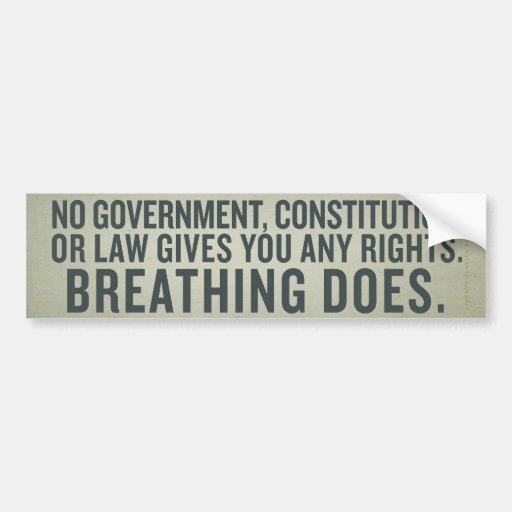
First, I believe that rights exist independent of any type
of state or government. I believe that they are given by God. States or
governments can recognize or fail to recognize these rights, but the rights are
still a person’s rights regardless of the decisions of those in power. Others
may attempt to coerce one into not exercising one’s rights or punish one for
doing so, but they are still, as the Declarationof Independence says, “inalienable rights.”
I think that there are a lot of rights that God has given
us. Still, Locke’s trio of life, liberty and property are a good place to start
because of their mutual balancing. Life is perhaps the easiest to understand.
No one can take another person’s life. Liberty is the right not to be coerced.
No one has the right to coerce another person into any action whatsoever.
Finally property, which is the ownership of what one earns or creates when
applying labor to nature’s abundance and God’s grace. No one has the right to
take another person’s property or tell him or her how to dispose of it.
The right to responsive violence:
But what if someone does? Sheltering these three rights and
a host of others is an assumed right that is rarely discussed: a right to responsive
violence. Should a person attempt to take your life, coerce you into anything
or attempt to confiscate or destroy your property, you have a right to engage
in violence equal to the necessity required to halt such infringement or die
trying. The right to responsive violence does not mean that you can infringe on
others’ rights to life, liberty or property. Your right to responsive violence
does not mean that you can take lives of those not currently attempting to take
yours. It does not mean that you can legitimately use violence to coerce
others. It does not mean that you can use violence in order to force others to
relinquish their property. The right to responsive violence does not allow for coercive
or preemptive violence. It means that one has the right to respond violently to
violent intrusion.
The Nation-State is Suspect.
In order to protect these inherent rights from violence,
people have traditionally banded together. One’s own inherent right to
responsive violence can be shared among a group so that if a neighbor’s life,
liberty or property is being violently assaulted, one can, with the neighbor’s
permission, work together to violently fend off such attacks. Furthermore, we
have found as a species that any number of our labors is more fruitful and
enjoyable when shared. However, there are limits on the extent to which we can
share. Coercing a person into sharing his or her labor is chattel slavery. This
type of slavery violates notions of both liberty and property and has a huge
probability of ending in a violation of one’s right to life as well. Coercing a
person into sharing the fruits of his or her labor is theft and is a violation
of the right to property as well.
Because no one has the right to violate life, liberty or
property, the nation-state is a problematic concept. While people are able to
work together to pool resources and incorporate in order to better their lives,
protect their liberty and increase their property, they must be free to leave
such agreements whenever it is no longer satisfactory or it is coercion.
Coercion is a violation of liberty and is therefore wrong. It is such a
problematic concept that God declared that the formation of a nation-state a “rejection”
of Him (I Sam 8: 7). Smaller local and temporary governments were fine and
necessary. Voluntary grouping of individuals is a good thing. Coercion,
however, is wrong, always.
Nation-states have a tendency to use coercion not only on
those outside their borders but on their own citizens. Citizens regularly have
their labor confiscated in the form of taxes and while this is sometimes beneficial,
it is hardly ever consensual. Often behaviors are regulated in the form of laws
which if violated result in the loss of liberty, property or life. While these
behaviors, if violating others’ rights, should be met with responsive violence,
this is not always the case. Often laws are created with the idea of
preemptively attacking the “criminal” before such violations are carried out.
Such preemptive and coercive violence is always wrong. In fact, it is part of
an individual’s right to violence to return violence in such instances.
There is No Legitimate Monopoly on Violence.
Many thinkers, wishing to justify the nation-state, have
insisted that in the creation of the nation-state there is a simultaneous
construction of an entity which has a legitimate monopoly on violence. Of
course, I am thinking of Weber here, but even thinkers as recently as Presidents
George H. W. Bush and Barrack H. Obama have espoused this notion that
nation-states have a legitimate monopoly on violence. There are two major means
by which this is understood and both are wrong.
Certainly, a person can voluntarily pool resources with
others and make voluntary agreements to limit and direct his or her right to responsive
violence. It is reasonable for someone who is not particularly skilled at
martial affairs to engage in activities at which he or she is good and from the
proceeds of those activities engage someone more skilled in combat to engage in
responsive violence for him or her. In a free community, some might be employed
in various roles and the free trade of their skills and some of those skills
might be soldiers to whom the members of the community voluntarily contribute
to their welfare in return for not needing to focus on protective violence
themselves. However this does not constitute a true monopoly on violence
because any member of a free community, being free, could extricate him or
herself from this arrangement and take responsibility for responsive violence
on his or her own. Voluntary incorporation does not imply monopoly.
Others seem to imply that the creation of a nation-state
suddenly creates an entity that can legitimately engage in coercive and
preemptive violence. Of course, that’s what any bully wants you to believe,
that he or she has the right to be preemptively violent and coercive. This is a
dangerous mindset into which many people have bought and which has allowed many
people not to realize the rights that they have. These rights, however, are truly
inalienable. Neither the nation-state nor anyone else has the right to engage
in coercive or preemptive violence against anyone. No matter how beneficent the
leadership of the state feels that the coercion is, they have no legitimate
right to engage in it. Only responsive violence is ever legitimate and that is
held solely by the individuals whose personal sovereignty is violated. The
state cannot legitimately coerce a person.
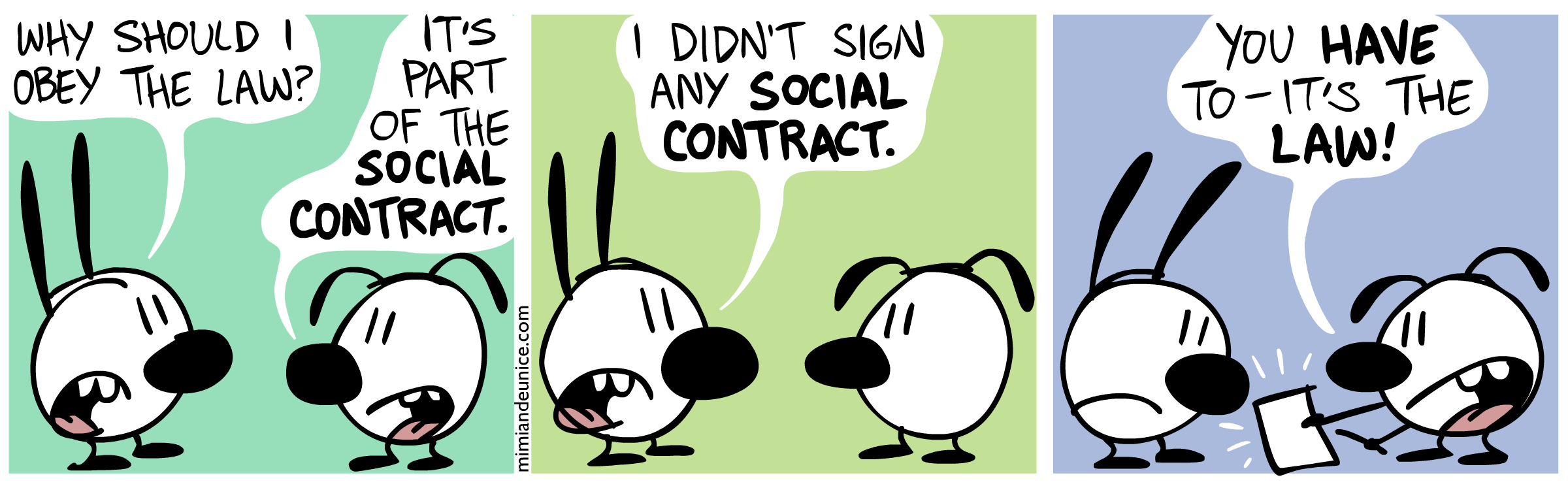
There is No Social Contract.
Some, such as Rouseau, have argued for the legitimacy of the
state as an instrument of violence by referring to a social contract. Since
contracts are a means by which people can willingly incorporate, share their
property and agree to means of enforcement, participation is not coercive or
preemptive because it is agreed upon by all signers. If I agree that I will
give you sixteen apples for sixteen oranges, get the oranges and refuse to give
you the apples, any violence in which you engage with me to get your sixteen
apples is not coercive violence but responsive violence because by lying, I
engaged in violence to fraudulently acquire your property. It is reasonable and
right that violators of contracts be violently held to the agreements by which they
acquired goods and services.
However, the existence of this social contract is seriously
in question and even if it does exist its validity is nullified. I never signed
a “social contract” and neither have you. The reason we’ve never signed one is
that one probably does not really exist. According to most people who accept
the concept of the social contract, we “signed” it by accepting the goods and
services of the nation-state and are therefore unable to remove ourselves from
it until our obligation is paid, which it never will be, and therefore we are chattel-slaves
to the state. The nation-state “signed” it by providing goods and services, such
as military protection. The problem with this is that we were not aware at the
time of our birth that by accepting being born into a world with roads and
bridges we were going to be forced into things like military conscription. If
we had been able to, we might have made another choice.
Contracts are a means by which free parties can negotiate
shared terms whereby they will agree to handle their business. The terms of the
social contract, however, are by no means a negotiation. Should a person wish
to interact with a nation-state on terms other than those chosen by the
nation-state, one is unable. Now, a take-it-or-leave-it contract does not necessarily
invalidate the contract, but there still does have to be the choice to leave
it. Any contract is invalid if signature on that contract is coerced. Choosing
a social contract is coerced, and claiming that the coercion of the nation
state is valid because of the social-contract is saying that coercion is acceptable
because of coercion.
So, whether on the grounds of a legitimate monopoly on
violence or on the grounds of a social contract, the nation state has
questionable validity. Certainly, it does not have the right to coercive
violence. No matter how much it may be in your own best interest, neither the
nation-state nor anyone else has the right to coerce you into anything.
Still, the nation-state exists.
The nation-state continues to exist and continues to coerce
and I don’t take up arms against it nor do I really encourage anyone else to do
so. There may be a lot of reasons for this. Maybe because I am of the dominant
race, gender, education level and class, a coercive nation-state is to my
obvious benefit. Most of the stuff that they’d coerce me into doing are things
that I’d probably do if they weren’t there anyway. They make me pay taxes, but
I contribute more to charity in a given year than to taxes. They have speed
limits, which I largely ignore except when I think they’re looking. Furthermore,
there’s probably some serious cowardice going on too. If I rose up against the
federal Government of the United States of America, I’d lose. So, I don’t. I
don’t recommend anyone else do it either. “We’ll put a boot in your ass, it’s
the American way” as the song says and Ruby Ridge and Waco prove.
Furthermore, America is far from the worst among
nation-states. I can publish this blog without fear of reprisal. You can’t do
that everywhere. There are also a number of means whereby I can contribute to
the conversation about coercion, property seizure and responsive violence. I
can make arguments that the government must not take away my right to
responsive violence, that I do not wholly abdicate that right to police or to
the military because don’t trust them. I can make arguments against the
preemptive and coercive use of violence. I can stand up and say that the
federal government needs to relinquish control to the states, the states need
to relinquish control to the counties and the counties need to allow decisions
to be made at small local levels.
So, yes, I am against federal gun control.
I have to be against federal gun control. The state uses
coercive means to preemptively stop crime and that is wrong. If one wants to
voluntarily create a community with strict gun standards that is fine, but no
one should be coerced into becoming a part of that community. I am also against
federal drug prohibitions. I am against the use of eminent domain. I am against
the federal recognition of marriage although I am strongly for marriage and am
happy to be married. I don’t believe that any kind of preemptive or coercive
law is right, no matter how much it may be “to protect” people.
Somewhere outside this sphere there are noises
of angry screaming, cussing, hurting sounds
which are coiled serpents dripping poisons
which are airless spaces where I will drown.
Somewhere outside this circle there is pain
where tortured people find someone to hurt
contagious hatred drives each one insane
each person grinds the other into dirt.
I feel that I must preserve this bubble;
smooth the fragile shell from penetration
for if I allow the smallest trouble,
then comes immolation, conflagration
Rising, Dragon, Phoenix from my downfall
king of demons, I will destroy them all.
Part of how I see myself is as a cosmopolitan American. By this I mean I’ve lived in America my whole life, but not any single part of America. I was born in western Nebraska, but my parents moved to Alaska soon after. We lived in a couple towns in Alaska before settling down for quite a few years in eastern Wyoming. After that we moved to western Nebraska again, then to central Nebraska. When my parents moved on, I stayed in central Nebraska before I moved to Ohio. From Ohio I moved to Virginia, then to Kansas. From Kansas I moved to Missouri. Then I was back in western Nebraska, but in a town I’d never lived in before.After that, I moved to where I live in southern New Mexico.
I see my roots as American. I love my country. Still, the roots are to ideals of frontier ingenuity, independent Christian faith, loyalty to family, hard work, liberty, which I see as loving others but letting them make their own mistakes, and freedom, which I see as the right of self determination. You know, America. Quite possibly all this applies to other countries too, but I think of them as America. Oh, sure I like the amber waves of grain and purple mountains majesty. I’ve seen the east coast, the west coast, the Gulf Coast and the Gulf of Alaska coast. Wherever I live, I see it as temporary. I see it as a place that I love and enjoy but from which I will move on when the time comes.
In general, when I move, I just move. I leave. I don’t miss a place. Since facebook, I’ve been able to have some sort of relationship with people I once lived near, but for the most part, I don’t really talk to people very much once I’ve moved away from them. It’s over. I don’t know if this is a coping skill I’ve learned because I moved so much or if it is part of who I am and has allowed me to move around so comfortably. I’ve liked them all, but my roots are not more ideological than geographic.
At least that’s the way I see myself. My parents, despite moving around quite a bit, have always seen themselves as being western Nebraskans. More than that, they see themselves as being from the North Platte Valley in the Scottsbluff region of the panhandle. My parents lived there growing up, their parents lived there their whole lives and I lived there for the end of junior high and the beginning of high school. We lived in a house built by my great grandfather and that we rented from my grandmother. While we were there, my parents saw themselves as “home.” I’ve always seen it as being another place where I lived one time.
This past summer, my parents moved back there. They moved back to the very same family house, and right now, I am there visiting them. It is weird. This house is owned by family, so I’ve been back a few times. It’s always been weird, but actually staying there is weirder. The house is different than it was when we lived here. First of all it is surrounded by a thick wind break: a necessity for this region where the wind can regularly gust into the 40mph range on a still day. On windy days, like yesterday, it just stays there. It was really nice to have it yesterday. My dad and I planted it in 1988 and I had to haul 5 gallon buckets of water out to those trees every day. I hated it.
Those trees, the trees I helped plant and water, are the strongest markers of the weirdness of this place. Generally, I do things, but I guess because I am always moving on I rarely see the consequences of my actions, rarely see the reaping of what I sow.
My Dad and I took his car into a mechanic. The mechanic had been one of the kids in the youth group when dad was a young minister. The mechanic came out and told me about how my dad had led him to Christ in the early 1970’s. He told me about how he had been able to grow in the faith himself, and how he witnesses to others through his business.It was like the trees. I know my Dad has been ministering for a long time, but it is only the immediate consequences of his work that I see and that I know.
I am who I have become and I don’t think that I could ever really become a person with geographic roots. I suppose this place where my family is from is as close as I’ll ever have.I am content with finding these. I am content with seeing these trees. I am content to come back and see these people. It’s enough. An old man in a green pickup truck drove in while I was walking my dogs yesterday and said “you must be a cousin.” I guess I must be. I guess this must be “home.”
I first entered the classroom as a
teacher in the Fall of 2000. I was a 24 year old college graduate who was being
allowed to teach college in order to help pay for graduate school. At the time
that made perfect sense to me. Now I wince at the idea of a person in his or
her twenties, who doesn’t even have a Master’s degree, being allowed to teach
college classes. Besides the university at which I taught during graduate
school, I’ve never worked at a place that made extensive use of graduate
students in the classroom. I dressed pretty much the way I’d dressed in college
with the exception that I now tucked my flannel into my jeans and buttoned it
up instead of letting it hang open. That was also basically the way they
dressed.
I did a lot of things like they
did. I went to the same bars and coffee shops and never felt weird about that.
I enjoyed the same websites and television shows as they did. Sometimes, during
a lull in the semester I’d walk the streets where the “party houses” were and
walk in and have an enjoyable time. I was also a student, albeit a “graduate”
student, so I still complained about professors, worried about grades and due
dates and got frustrated with the requirements of my program. I didn’t act or
dress that differently than my students because I wasn’t that different from
then.
While I was in graduate school, styles
changed, but I didn’t. I was still pretty much dwelling at the nicer end of the
grunge era. Students’ choices in clothes were changing. Off the rack designer
clothes became more popular. Hoodies, with the name of the designer,
fraternity, sorority or sports team replaced flannels for every day wear.
Students also started to wear what they deemed “nicer” clothes from time to
time too. That was where the problem came in.
I’ve never cared a huge amount
about clothes. I prefer not to be seen in public wearing a pullover t-shirt. I
still, however, love flannel. However, any button down shirt is fine with me. I
wear jeans or comfortable, casual slacks. I often wear a suit jacket or sport
coat nowadays, but not really a “suit” as it would be understood in a business
context. I’ve always understood the need for ties and dress shoes for job
interviews and big presentations, but would never spend a huge amount of money
on such things. My very “best” clothes all come from thrift stores. The rest
come from big box retailers. I almost never set foot in a traditional “department
store.”
My students, for almost a decade
now, really do spend a lot of money on clothes. It is nothing for them to spend
$15-$25 on a t-shirt. $80 pants are common. The amount they say they spend of
shoes blows my mind to the point that I don’t actually believe them. I know how
much they spend because every once in a while they mention it. Generally one
compliments another and then the other explains where they got the clothes and
how much they cost.
That’s all fine and dandy. My
students spend more money on clothes than me. They also drive more expensive
cars, eat at more expensive restaurants, have more expensive phones and
computers and refuse to make use of the free, public transportation offered to
them. They’re idiots, but they’re young. I used to blow a lot of money on cigarettes.
Clothes are healthier.
The thing about clothes, however,
is that it is one area where it puts me in an awkward position as a speech
teacher. I deal with clothing three times during the semester. When I hand out
the syllabus, I explain that they should make sure that they have clothing that
is “a little better” for speeches. When I talk about delivery and nonverbal
communication, I talk about “what your clothing communicates.” When I talk
about decorum in the context of ethos, I talk about “fitting and appropriate”
clothing.
Then students give their speeches.
Inevitably, there will be many who wear a t-shirt and jeans. I don’t really
dock them for this exactly, they just don’t get any extra points. In many ways,
I see a t-shirt and jeans as fitting the classical rhetorical concept of
decorum when speaking as a college student in the early part of the 21st
century. Then I have some who come in wearing their pajamas or workout sweats.
I generally dock them just slightly. Then I have a few who will put on the
sport coat, the tie, the dress shoes. I tend to give them extra points.
Then I have one other set. They are
usually women. On normal class days, they wear jeans and a t-shirt. Then, for
the speech day, they decide to “dress up.” Dressing up, however, does not quite
mean what I expect them to mean. Let me describe for you a student who did this
today. She wore makeup, which she doesn’t usually do to class. Her hair was
done in a braid across the front to hold the rest back. She was wearing earrings
and a matching necklace. She wore a blouse with a deep v-neck. The blouse was
designed so that the three buttons right at her chest were to be buttoned. The
lower half of the blouse was designed to be tied in a knot, in order to expose
the midriff. She had her belly button pierced and a chain, which matched her
necklace and her earrings, dangled from the piercing down to her belt. The belt
surrounded a tight-fitting, black, shimmering skirt that did not entirely cover
the thigh. Thus, bare skin was exposed until just below the knee when a pair of
long, black, high-heeled boots, made out of the same material as the skirt, covered
her calves and feet completely.
Not my student, but you get the idea
I rewrote the previous paragraph
four times before I realized a philosophical trap in even writing about it. I
was trying to objectively describe her clothing without objectifying her.
Unfortunately, “objectively” and “objectify” sound similar for a reason. Describing something objectively is the means
by which one objectifies it. A more subjective description, saying that the
clothing was “more appropriate for the nightclub than the classroom” (which is
what I wrote on her evaluation) would not have conveyed the precise
difficulties with the clothing in question.
And that becomes the difficulty in
explaining to the student a couple of points docked for clothing. I know that
it will be a difficulty for the student because she obviously was wanting extra
points. She was thinking about “dressing up” for the extra points that she knew
others had gotten when putting on better clothes than jeans and a t-shirt. I don’t know whether or not the student will
contest the grade. When a student doesn’t contest his or her grades, teaching
stops with the evaluation. So, the good teacher in me hopes that she will
demand some kind of explanation. There is another huge part of me that hopes
she doesn’t because it is always awkward. Students come to a number of
conclusions, none of which are correct.
Dr. Cline doesn’t like me. This is a common
complaint when anyone receives a poor grade. It is almost never true.
Dr. Cline doesn’t like girls. Women, on average,
get higher grades in my classes. That is because, on the whole, they are more
dedicated than males. It is these particular students who dress inappropriately
who get worse grades.
Dr. Cline likes me, you know what I mean? This
is my biggest fear. I think it is every male professor’s biggest fear: the idea
that a student will think I am a dirty old man being turned on by some young
woman’s attire and taking out my frustrations on her grade. Either a positive
response, that such attentions would be welcomed, or negative response, that
such attentions are sexual harassment both concern me.
Dr. Cline thinks I’m ugly. I am NOT saying “You
look disgusting! Cover it up!” I am saying that this is not what one should
wear for a speech.
Dr. Cline thinks I’m a scarlet woman. Of course,
that’s not the language which students use, but I don’t use the words they do.
I’ve had students to whom I’ve recommended less social clothing think that I am
commenting on their morality. In general, I have no idea what my students moral
feelings are and I like it that way.
I have dressed too informally for a speech. I’ve
had students whom I have corrected in this way then take the next step up and
appear in formal gowns the next time.
I have overdressed for a speech. The problem isn’t
really over or under dressing. It is the clothes for the time and the place
that matter.
It was the belly button piercing. Or the skirt,
or the shirt or any particular part of the ensemble.No, it was the appropriateness of the whole.
Dr. Cline is just old fashioned. I don’t think
this is the case. I think that even as society has changed there remains a
difference between business clothing and evening clothing.
Dr. Cline is just a prude. Maybe. I don’t know. Still,
I think that awareness of such prudishness in the general population will help
you in life.
What will probably happen is she will just take the grade
and shut up, but I worry.
This morning I got
on a scale and saw something that I hadn't seen in a few years. My weight was
under 280 lbs. This is a real significant weight for me, but not the way that
it would be for most people.
All through
college, my weight was within two or three pounds of this number. Sometimes it
was over, then it would get back under. It was pretty stable. I knew I was fat,
and felt bad about it, I guess, as I knew I should. But I didn't care that
much. I couldn't run races or do a chin-up, but I didn't really want to do
those things either. Especially at that age, I wanted people to find me
attractive. Still, I figured if anyone didn't find me attractive, it was
because they were shallow. I thought most people were shallow. I thought of
myself as being all intellectual and spiritual and creative and stuff. I didn't
care about my health. Health concerns were shallow.
In graduate
school, I got really, really fat. When I turned 30, the number repeated itself
in my life in a way that I found fascinating. I will not tire you with all
the synchronicity, but one was that I weighed 330 lbs. While I still
didn't want to be shallow, I recognized this as somewhat ridiculous. Besides,
my spirituality was reaching a point where I was seeing a certain value
in asceticism and abstention from all kinds of pleasures as a
means of putting the flesh under subjection. Increasing my activity level,
especially walking and swimming, and decreasing my calorie intake, including
regular fasting, resulted in weight loss. I dropped the 50 lbs real, real quick
and was back to 280. At that point I hit kind of a plateau. I continued to lose
weight for a while, but slowly. Eventually, I got down to around 260, which is
the least I ever weighed in my adult life.
Then I got a
tenure track job, which I thought was going to be awesome, but wasn't. I had a
chair that didn't respect me: who didn't see me as the brilliant man I knew I
was. I engaged in stress-related eating and also decreased my activity level.
There was also a wonderful, wonderful brewery in town which sold some pretty
high calorie beer and a wonderful fried dough called grebel. I put on weight.
After this, I
switched jobs. I got another tenure-track position at a place I loved. It was a
great little private liberal arts school. I would have stayed there
forever. It was great. We had around 800 students. I knew them all and many of
their parents. The relationships we had were fostered by, among other things,
eating at the cafeteria together. While college students can probably handle
the greasy faire of the cafeteria, it was not good for me. I put on weight.
Then they decided not to renew my contract. I’ve almost settled my
soul on the idea that I will never really know why in this life. Still, it
strongly affected me. It was like hearing that your family no longer wants you
around. It was killing me. It took me well over a year to find another academic
job and I could barely stand it. What money I did have, I used on food and I
put on weight.
Finally, I did get the job where I am currently employed. It is a
great place up in the mountains of southern New Mexico. The natural activities
around here actually caused me to lose some weight for a while. I checked after
New Years of that year and found my weight where it is now, about 280. I was
comfortable with my job. I was honestly comfortable with my weight. I didn’t
mind that I was a bit fat. I was happy.
Then my wife and I decided to get serious about having kids. I
assumed that was all it would take to have kids, but it’s been hard. So, we
decided to adopt. We were denied that opportunity. So, we got angry and
depressed. And I put on weight.
This picture is not us. We're not Asian.
Sometime after Christmas, I got back up to a point I hoped I’d
never reach again. I was well over 300 lbs. Still, I am nowhere near my
fattest, but 300 is just too fat, so I increased my activity level and
decreased my calorie intake. Since New Years, I’ve lost almost 25 lbs. The
truth is that the increased activity level has helped with the depression,
which I’d have to say is completely gone now.
Now I am down below 280. I am actually at a weight where I am
comfortable, but I shouldn’t be. At my height, 280 still has a BMI of 39. For
medical professionals who use BMI as a measurement of “morbidly obese” or "severely obese"(which
not all of them do) 39 is the line. Between 30 and 39 is still “obese” and I’d
still need to lose 65 lbs to get down to “overweight.”
So, somehow, I have to make myself continue to be uncomfortable
with where I am. I always tell my students that they should be “proud of [their]
progress, but not [their] position.” I mean a lot of things by that. I mean
they shouldn’t see what they’ve achieved as a reason to look down on others. I
mean that they shouldn’t be upset that they haven’t “arrived” yet. I also mean
that they shouldn’t be satisfied with where they are, they shouldn’t see their
position as adequate.
That’s how I need to be right now. I need to be proud of my
progress, but not of my position. It is just going to take some mental work to
get there.
I am all for newer media. Cable television, streaming video,
blogging, social networking, digital readers, smart phones, texting and free
wireless networking at most fast-food locations have made life far easier in
many ways and facilitate communication that would have been difficult in times
past. Furthermore, I see the potential for the increasing work in new media
providing ground for the increase in undergraduate study of rhetoric in order
to facilitate content creation.
Right now, communication as a discipline has not caught up
with these advances, and possibly to be the best we can be, we shouldn’t try.
Training students in particular technology is setting them up to experience obsolescence
as soon as they graduate. Instead, we should probably focus on universal
rhetorical principles that seem to make sense regardless of technology, such as
those reaching clear back to Aristotle’s On
Rhetoric. Nonetheless, what we should do is make sure the students
understand the concept of universal principles themselves and that what they
learn in one class should be applicable to others.
Perhaps one of the universal principles that we need to make
sure they understand is one that was articulated by Marshall McLuhan half a
century ago; with every advancement in technology, there is a trade off. The
mobile phone and the related drop in the rates of transmission costs due to
improved bandwidth is a good example. I remember as a child my mother lamenting
that she would like to talk to her mother (my grandmother), but the cost of a
telephone call was prohibitive. By the time I got to college, 10₵
per minute was the going rate of a domestic call. I developed a habit of
talking to my parents who lived four hours away at least weekly. However, at 10₵ a
minute, it was still quite outside a college student’s budget to call often.
So, I would call my parents, let it ring three times and they’d call me back. I
was well aware of how wonderful it was the phone calls were so cheap! That cost
has plummeted. Now, most of my students call their mothers between classes. It
is a stereotype that students come out of an exam crying on their phones that “the
professor is so mean” and that “there were questions on the test we never
discussed in class” (in my class, that is always true because I expect students
to do the reading as well as attend class).
All of this is truly wonderful. It really, really is. Because
of changes in media, my students have a connection to family that is deep and
lasting and that I can’t really understand. My parents knew that when we
separated, we were separating. We knew that the relationship was changing. When
I speak to my parents, whether it is by telephone (which does not happen every
day) or when I get to make a rare appearance in person, it is a call for
celebration, a reunion, a joy for all parties. For people today, family
reunions will be something of a redundancy, even though they live further apart
than ever. My students’ parents never really separate from their children. This
attachment to family that began in the millennial generation and that continues
today is something that those of us from generation X and older look on with a
bit of wonder, sometimes envy and sometimes revulsion.
Why both envy and revulsion? Because there is a trade off.
The one that concerns my colleagues and me the most is the lack of independence
on the part of our students. Every problem, every difficulty, every heart-break
and let down results in a call to Mom (always Mom, never Dad ((perhaps a
subject of another blog because that is certainly something with which we need
to come to terms))). Even as a grade schooler, my relationship with my parents
was not as close as the average college student’s relationship with her or his
parents. While I envy that closeness, I am revolted by the fact that these
seeming adults cannot “cut the cord,” as the metaphor goes, and live a life
that is independent from their parents.
A similar set of revulsion and wonder can be paid to the way
that news, especially political news, is disseminated. As a child, my parents
followed pretty traditional gender roles with the exception that my father did
most of the grocery shopping. Sometimes, he would return from the grocery store
with a paper bag filled with groceries and a copy of Newsweek, a news magazine
that no longer even exists today. In those days, grocery stores sold news
magazines, which is something that they absolutely do not do now. When we had a
television, which we only had off and on growing up, my Dad would try to watch
the evening news most days. My Dad is a fairly conservative guy (a picture of “compassionate
conservatism”), and would often complain of the liberal bias in his news
magazine and his news television programs, but continued to consume the media.
No doubt something similar happened in liberal households throughout the United
States at that time. A conservative bias per se in media was probably not a
complaint but a “pro-establishment,” “pro-management” or “anti-labor” sentiment
probably irked the more liberal consumers who continued to consume the news
available.
There were quite a few intentionally right-wing or left-wing
weekly publications that were being produced as well. I know that I saw
Christianity Today and several hunting and fishing magazines that espoused an
openly conservative bias in my home as a kid. My guess is that the average
liberal household did not have many of these passing through their mailboxes.
My father was never a subscriber to widely focused conservative magazines such
as National Review, but that was probably because it is kind of expensive.
Growing up in a conservative household has led me to become
kind of a conservative guy myself, though more Libertarian than Republican. My
grandmother subscribed me to Time (the last remaining general news weekly), so
I read that with the same eye rolling with which my father read Newsweek. I am
a subscriber to National Review. Real Simple, Reader’s Digest and People also
come to my mailbox due to my wife’s interests and I find myself reading them
far more often than I am comfortable admitting. Print media in various forms takes up a
significant portion of my home and positively fills my office.
There is another way I consume news too. I consume news on
the internet. I used to consume news via various cable channels as well, and if
we can ever adjust our finances, I’d like to again. Still, there is a huge
difference that works itself into differences in these new media than what was happening
in print.
I would take my subscription to National Review as a prime
example. Because it has an openly political bias, one can easily compare it to
new media with similar bias. The latest edition of the National Review magazine
deals with the national issue of gun control. It deals with it in a careful,
reasoned and thoughtful way. It is a conservative publication, so the careful,
reasoned and thoughtful arguments lead to the conclusion that gun control
should be focused on limiting government control, rather than restricting individual
rights (see, I’m biased too). To read the articles in the print magazine, I had
to turn to a dictionary at least twice that I remember. I was also quite
thankful for some training in political philosophy so that I could understand
the nuances of the arguments they were making. The articles were written in a
polished, unhurried manner making extensive use of intellectual vocabulary,
historical precedent and critical syllogistic reasoning. While a liberal would
undoubtedly disagree with most of the axioms and some of the reasoning, no
liberal would read the print copy of the National Review and come to the
conclusion that conservatives were crazy. There is a bias, but that bias is
explained, not assumed.
Compare this to newer media with similar bias. Watching Fox
News editorials, or engaging with the major political blogs like Breitbart, or
even looking at National Review’s website, rather than their print publication,
provides interesting points of analysis. The language is simple and terse, even
rude to those who might disagree. The philosophical analysis is non-existent. The
sites are designed to cause cursory clicking from one page to the next. The
editorials are reduced to the literal shouting of talking points. They are
dismissive of those who would disagree and use constant hyperbole (intentional
overstatement), mockery (making fun), flooding (making vast lists of charges
with varying degrees of veracity as though they were all equal) and ad hominem
(name calling). This is exacerbated by blogging and private video creation as
well. This rude, extremist meanness is often funny, but does now really add to
the conversation. This video, for instance, is funny, but does not add to any
kind of intelligent debate.
Of course, some liberals see this as a purely conservative
problem. I engage with more than enough left-wing media to know that knew media
on the left is equally guilty of these charges. In fact, several of my
left-leaning friends proudly shared this video of Rachel Maddow engaged in all
four of the rhetorical fallacies outlined above.
Still, I don’t see the new news system as “bad” exactly.
There are real advantages. There are advantages to the ease with which one can
find like minded media. Certainly, this adds to confirmation bias, and
tribalism, but a Democrat in Alabama or a Republican in Vermont can realize
that they are not all alone in the world. Realizing that one is not all alone
is a good thing, really. The speed at which new information can spread is
wonderful. When Governor Romney made his infamous “47%” remark this last
election season, he had to defend it right away. New media made this something
that was not just rumor or innuendo. The recording was right there. As much as
I did not favor the President in this election (but didn’t vote for either
major party), I still believe that this was as it should be. Controversial
statements should be discussed, not denied. The slow media of network news at
five o’clock and weekly magazine coverage could not have made the discussion
happen. It did happen, however, and at least partially because it happened,
America, in the majority, chose Obama.
I like that I can write this blog. I know that very few
people will actually read it, and it functions more, as my subtitle implies, as
a means for me to “come to terms” with various and sundry topics. I like that
it is something more public than a journal. I like that anyone can blog and
some can become very successful at it. I like that freedom, that liberty, which
lower cost publication has afforded to all of us. Unfortunately, the drive to
click and garner quick agreement does have its draw backs. Some people who come
across this blog may not bookmark it because I use big words or have political
opinions different from theirs. There is
a trade off in the movement to new media.
And that is the real point of this posting. Changing media
involves trade offs. It is not a new or original idea, but it is one with which
I am coming to terms right now.